


Progress, Power, and the Uneasy Birth of the Modern World
Introduction: A World Changing Too Fast to Understand
The Victorian era is often remembered as an age of invention—steam engines, telegraphs, railways, gaslight, electricity. It was, by every measurable standard, an age of progress.
And yet—
It was also an age of fear.
Beneath the polished brass and iron triumphs of industry lay a growing unease:
What happens when humanity creates something it no longer fully understands—or controls?
For the Victorians, technology did not simply improve life. It disrupted it, challenged belief systems, and blurred the boundaries between the natural and the unnatural.
The Industrial Revolution: Power Without Precedent


The Industrial Revolution transformed Britain into what many proudly called the workshop of the world, a vast engine of production driven by iron, steam, and relentless human labor. Steam power surged through factories, propelled locomotives across the countryside, and carried ships beyond familiar shores at speeds that would have seemed impossible only decades earlier. It was an age defined by motion—by the constant turning of gears, the pounding of pistons, and the ceaseless demand for more.
Yet beneath this triumph of industry lay a growing unease.
Cities swelled at a pace that outstripped planning or comfort, their streets crowded with laborers drawn from the countryside by the promise—or necessity—of work. What had once been villages and fields gave way to dense rows of brick and smoke, where entire families lived in narrow quarters under the shadow of factory walls. The rhythms of rural life, once governed by seasons and sunlight, were replaced by the rigid, unyielding schedule of the clock and the factory bell.
Within those factories, the nature of work itself began to change. Laborers were no longer craftsmen shaping materials with skill and autonomy, but operators tending machines, their movements dictated by mechanical rhythm. The human body was expected to keep pace with iron and steam, to repeat the same motions hour after hour without deviation or fatigue. In this new order, the line between man and machine grew increasingly difficult to discern.
At the same time, the environment itself bore the marks of this transformation. Smoke thickened the air, turning skies a perpetual gray and coating buildings in soot. Rivers, once clear, carried the refuse of industry, and the very act of breathing became, in some districts, an act of endurance. Progress had not come cleanly; it had come with a cost that could be seen, felt, and inhaled.
It is little wonder, then, that writers and social critics began to question whether this new world represented advancement or imbalance. Figures such as Charles Dickens depicted industrial society not as a triumph, but as a place of dehumanization, where individuals were reduced to functions within a larger, indifferent system. The concern was not merely economic or environmental—it was profoundly human. What becomes of identity, of dignity, of the soul, in a world that values efficiency above all else?
Machines did not tire. They did not feel. They did not question the purpose of their labor. And increasingly, it seemed that society itself was beginning to demand the same qualities from those who lived within it.
The Telegraph: The First Internet—and the First Anxiety About It


When the telegraph emerged in the mid-nineteenth century, it did more than revolutionize communication—it redefined the very structure of human experience. For the first time in history, messages could travel faster than the people who sent them, carried not by horse or ship, but by pulses of electricity racing along wires that stretched across cities, countries, and eventually oceans. Distance, once an undeniable barrier, seemed to collapse under the weight of this new invention.
Yet this transformation was not experienced as simple progress. It was, for many, profoundly disorienting.
Information no longer arrived through lived experience or physical journey. News could be received from hundreds of miles away in the span of moments, stripped of the gradual context that travel once provided. Events unfolded elsewhere and yet appeared immediately present, as though reality itself had begun to fracture—no longer bound to place, but dispersed across an invisible network of signals. Time, too, seemed to compress. The natural rhythm of waiting, of anticipation, of sequential understanding gave way to something abrupt and instantaneous.
Some Victorians greeted this with awe, seeing in the telegraph a triumph of human ingenuity and a promise of global connection. Others, however, found it deeply unsettling. The notion that unseen currents carried meaning through the air—or through wires that seemed almost incidental to the phenomenon—introduced a new kind of anxiety, one that bordered on the uncanny.
Questions arose that blurred the line between science and superstition. If messages could be transmitted invisibly across great distances, what else might be traveling unseen around them? Could these electrical currents influence the human body or mind in ways not yet understood? Were individuals now constantly surrounded by forces that could not be perceived, yet were undeniably present? In an age already grappling with spiritualism and the possibility of unseen worlds, the telegraph seemed to offer a technological counterpart—a system that operated beyond the limits of ordinary perception.
What made the telegraph particularly unsettling was not merely its speed, but its invisibility. It functioned through processes that most could not observe or fully comprehend, creating a quiet dependency on systems that operated out of sight. Communication, once tangible and traceable, became abstract—reduced to coded signals and distant transmissions.
In this way, the telegraph introduced a fear that feels strikingly familiar even now: the fear of invisible systems shaping reality behind the scenes, of forces that connect and control without ever being fully seen. It was the beginning of a new kind of uncertainty—one in which the world remained connected, but no longer entirely knowable.
Electricity and Galvanism: The Spark of Life—and Death


Electricity, in its early days, was not fully understood—it was as much spectacle as it was science. To Victorian audiences, it appeared less like a natural force and more like something newly stolen from the fabric of creation itself. Demonstrations of galvanism, particularly those inspired by the experiments of Luigi Galvani and later popularized across Europe, drew crowds who watched in uneasy fascination as electric currents caused the limbs of dead animals—and, in some cases, human cadavers—to twitch, shudder, and move as though stirred by some lingering fragment of life.
These exhibitions did more than entertain. They unsettled.
For the first time, the boundary between life and death no longer appeared fixed or sacred, but permeable—subject, perhaps, to human intervention. The question that followed was as inevitable as it was disturbing: if electricity could animate dead tissue, what separated such motion from life itself? And if that line could be crossed, who—or what—had the right to cross it?
This anxiety found its most enduring literary expression in Frankenstein, where the act of creation is stripped of divine sanction and placed instead in the hands of an ambitious scientist. Victor Frankenstein does not merely experiment; he trespasses. He assembles life without fully understanding it, harnesses power without moral restraint, and in doing so embodies a fear that extended far beyond fiction: that science, once unbound from ethical limits, might pursue knowledge at the cost of humanity itself.
Electricity, then, was never simply a tool in the Victorian imagination. It became a symbol—of possibility, certainly, but also of transgression. It represented a force that could illuminate the world or unmake it, depending on the will of those who wielded it. And perhaps most unsettling of all, it suggested that mankind had begun to reach into domains that were never meant to be touched.
Railways: Speed, Space, and Psychological Shock


Railways did more than shorten distances—they redefined them, altering not only how people moved through space, but how they perceived it. Journeys that once unfolded over days, marked by gradual transitions of landscape and atmosphere, could now be completed in a matter of hours. The countryside no longer revealed itself in a slow and comprehensible progression; instead, it rushed past the window in a blur of motion, fragments of the world glimpsed and lost before the mind could fully register them.
This acceleration was not universally welcomed. For many Victorians, it introduced a profound psychological strain, as though the human body had been forced into a pace for which it had never been designed. The experience of high-speed travel unsettled the senses, producing a strange dissonance between physical stillness and environmental motion. One remained seated, contained within the carriage, while the world itself appeared to race uncontrollably beyond the glass.
Medical authorities began to take these concerns seriously. What came to be known as “railway spine” emerged as a diagnosis intended to account for a range of symptoms—nervous shock, chronic pain, fatigue, and anxiety—often reported by those involved in railway accidents or subjected to prolonged travel. While some cases were clearly linked to physical injury, others seemed rooted in something less tangible: the trauma of speed, of impact, of a world suddenly rendered unstable by mechanical force.
There was also the ever-present specter of catastrophe. Railway accidents, when they occurred, were often sudden and devastating, their violence amplified by the very speed that made the technology so remarkable. Collisions, derailments, and mechanical failures introduced a new kind of fear—one in which death could arrive not through illness or misfortune, but through the failure of an intricate system moving too fast to stop.
Beneath these practical concerns lay something deeper and more difficult to articulate. The railway did not simply transport the body; it disrupted the continuity of experience. Space itself seemed to contract, while time lost its familiar rhythm, creating a world that felt at once more connected and less stable. The journey, once an essential part of understanding distance and place, became an interval to be endured rather than experienced.
In this way, the railway altered more than geography. It reshaped perception, forcing individuals to confront a reality that moved faster than their senses could comfortably interpret—a reality in which progress came not as a gentle unfolding, but as a sudden and irreversible acceleration.
Mechanization and the Fear of Replacement


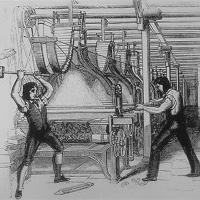
As machines grew more capable, a deeper and more unsettling question began to take shape beneath the surface of industrial progress: what, precisely, was the place of the human being in a mechanized world? The concern was not merely theoretical. It emerged from lived experience, from the steady erosion of traditional forms of labor and identity that had once defined both livelihood and purpose.
Skilled artisans—men and women whose trades had been honed over years of practice—found themselves displaced by machines that could produce faster, cheaper, and with relentless consistency. Work that had once required judgment, creativity, and individual mastery was reduced to repetition, or eliminated altogether. In response, resistance arose, most famously in the form of the Luddite movement, whose members did not simply protest change but actively destroyed the machines they believed threatened their survival. Their actions were often dismissed as reactionary, yet beneath them lay a profound and prescient fear: that technology, once introduced, could not be restrained, and that its consequences would not be evenly borne.
Within the factory system, this transformation extended beyond employment into the very nature of human existence. Workers were no longer independent agents shaping their craft, but components within a larger industrial mechanism. Their labor was measured, timed, and regulated, their value increasingly defined by efficiency rather than individuality. The machine did not adapt to the human; the human was expected to adapt to the machine.
This gave rise to a fear that was not solely economic, but existential. If a machine could perform the same task more reliably than a person, what distinguished the two in any meaningful sense? And if that distinction continued to erode, what remained of human purpose?
It is a question that did not end with the Victorian era. It persists—perhaps more urgently than ever—in contemporary anxieties surrounding automation, robotics, and artificial intelligence. Today, as algorithms compose text, generate images, and make decisions once reserved for human judgment, we find ourselves confronting a familiar unease. The tools have changed, but the underlying concern remains strikingly similar: not simply that machines can do what we do, but that they may one day do it better, faster, and without need of us at all.
In this continuity, the Victorian fear of mechanization reveals itself not as an outdated response to early industry, but as the first articulation of a modern dilemma. It asks a question that still lingers, unresolved and deeply human: if we are no longer defined by what we produce, then what, at last, defines us?
Science vs. The Soul: A Crisis of Belief
Technology did not emerge in isolation. It pressed itself into the very heart of Victorian thought, colliding with long-held beliefs about religion, philosophy, and the nature of existence itself. Each new discovery did not simply explain the world—it unsettled it, forcing society to reconsider foundations that had once seemed immovable.
As science advanced, it began to offer explanations for phenomena that had previously been attributed to divine will or supernatural influence. This created a quiet but persistent crisis of belief. If the workings of the universe could be reduced to natural laws, carefully observed and replicated, then what became of the soul? If life itself could be studied, manipulated, or even artificially stimulated, what did that suggest about divine creation? And perhaps most unsettling of all, if invisible forces such as electricity and magnetism could move through the world unseen yet undeniably real, what, then, distinguished them from the forces long associated with the supernatural?
These were not merely academic questions. They struck at the core of identity, belief, and meaning.
Rather than resolving this tension, scientific progress seemed to deepen it. The more the physical world was explained, the more urgent became the need to understand what lay beyond it. In this atmosphere of uncertainty, movements such as Spiritualism gained remarkable traction, offering the promise that the unseen could still be accessed, studied, and perhaps even proven. Séances, mediums, and spirit communication became not fringe curiosities, but widespread cultural practices, embraced by those who sought to reconcile the authority of science with the persistence of the soul.
What is particularly striking is that these pursuits often adopted the language and methods of science itself. Investigations into spirit phenomena were conducted with an air of experimentation, as though the afterlife might be measured, documented, and verified like any other natural process. The boundary between science and the supernatural did not disappear—it blurred, becoming a space of uneasy overlap where certainty proved elusive.
In this way, Victorian society did not simply choose between science and belief. It attempted, with varying success, to hold both at once.
And in a quiet irony that defines the era, the advance of scientific understanding did not banish the unseen. Instead, it intensified the desire to prove that something beyond it still remained.
Literature as a Mirror of Fear
Victorian fiction did not merely reflect the anxieties of its age—it transformed them, giving shape and narrative to fears that were otherwise difficult to articulate. In an era defined by rapid scientific advancement and technological upheaval, literature became a kind of testing ground, a space in which the consequences of progress could be explored not as theory, but as lived—and often terrifying—experience.
In Frankenstein, the fear of scientific creation is rendered with haunting clarity. The novel does not simply ask whether humanity can create life, but whether it should. Victor Frankenstein’s experiment is not portrayed as a triumph of intellect, but as a profound moral failure—an act of ambition divorced from responsibility. The creature itself, tragic and misunderstood, becomes a reflection of the deeper anxiety: that creation without understanding produces not mastery, but consequence.
This theme evolves in The Strange Case of Dr. Jekyll and Mr. Hyde, where the threat is no longer external, but internal. Here, science does not animate the dead, but fractures the self. The fear is not of what humanity might create, but of what it might reveal—that beneath the veneer of civility lies something darker, something uncontrollable. The transformation of Jekyll into Hyde suggests that progress, rather than refining human nature, may instead expose its most dangerous impulses.
In Dracula, these anxieties take on a broader cultural dimension. The novel situates ancient, supernatural horror within a modern world equipped with the tools of science—typewriters, blood transfusions, and early forms of data collection. Yet these technologies, for all their precision, prove insufficient to fully comprehend or contain the threat. Dracula is not defeated by science alone, but through a convergence of knowledge systems, suggesting that modernity, for all its advancements, remains vulnerable to forces it cannot entirely explain.
What unites these works is not simply their subject matter, but their underlying insight: that technology and science do not eradicate fear. Instead, they reshape it, displacing old anxieties and giving rise to new ones. The unknown does not vanish under the light of discovery; it recedes, shifts, and returns in altered form.
In this way, Victorian literature serves as both mirror and magnifier. It reflects the uncertainties of its time, even as it intensifies them, revealing a truth that continues to resonate: that every advance in knowledge brings with it not only understanding, but new and unforeseen shadows.
A Subtle Reflection in Theater of Spirits
In Theater of Spirits, by Robin Trent, this tension does not announce itself openly. It lingers—quiet, persistent—just beneath the surface of every investigation, every conversation, every unanswered question. The world presented is not one of clear divisions, but of uneasy coexistence, where rational inquiry and supernatural perception move alongside one another without ever fully reconciling.
On one side stand Barnes and Dickman, representatives of order, evidence, and the growing authority of institutional logic. Their methods are grounded in observation, deduction, and the belief that truth, however obscured, can ultimately be uncovered through disciplined inquiry. On the other stands Thaddeus Priest, whose experiences resist such containment, drawing him into encounters that cannot be measured, cataloged, or explained away. He does not reject reason, but he is not protected by it either.
What emerges is not a conflict of belief, but a fracture in understanding.
The question is never simply what is real. That, perhaps, would be too easy. Instead, the narrative lingers on something far more unsettling: what happens when reality itself refuses to conform to a single explanation? When evidence points in one direction, and experience in another? When the world can be interpreted through multiple frameworks, each convincing, each incomplete?
This is the quiet inheritance of Victorian technological anxiety—not the fear that science will fail, but the fear that it will succeed, and still leave something unresolved. That it will illuminate the mechanisms of the world while leaving its deeper truths untouched.
In such a world, knowledge does not bring closure. It introduces contradiction.
And so the tension remains: a reality in which science explains too much—and yet, somehow, never enough.
Conclusion: The Birth of Modern Fear
The Victorian fear of technology was not irrational. It was, in many ways, profoundly perceptive.
They stood at the threshold of the modern world, witnessing changes that unfolded with a speed and force unlike anything that had come before. In that moment of transition, they recognized something that remains difficult to fully confront even now: that progress is not a simple ascent, but a transformation—one that reshapes not only the world, but the human experience within it.
They saw the beginnings of a loss of control, as systems grew larger, faster, and more complex than any single individual could fully comprehend. They felt the acceleration of change, as time itself seemed to compress under the weight of invention. And they grappled with the ethical ambiguity of innovation, understanding that the same forces capable of advancing society could just as easily unsettle or harm it.
These were not distant or abstract concerns. They were immediate, lived, and deeply human.
What the Victorians understood—perhaps more clearly than we do now, accustomed as we are to constant advancement—is that fear does not vanish in the presence of progress. It adapts. It evolves. It finds new forms within the very systems designed to overcome it.
In this sense, their anxiety was not a failure of imagination, but a recognition of its limits. They did not simply fear what technology might do. They feared what it might reveal—about the world, about power, and about themselves.
And in that recognition lies their enduring relevance.
For we have not left their world behind.
We have continued it.
Footnote Sources
- Briggs, Asa. Victorian Things
- Carey, John. The Intellectuals and the Masses
- Otis, Laura. Networking: Communicating with Bodies and Machines in the Nineteenth Century
- Schivelbusch, Wolfgang. The Railway Journey
- Morus, Iwan Rhys. The Shock of the Old: Technology and Global History since 1900
- Winter, Alison. Mesmerized: Powers of Mind in Victorian Britain
📜 Filed in the Dark Muse Press Library under DMC 250.1
Victorian Culture & History → Fear of Progress


⇦ Shut the Drawer
Return to the Catalogue